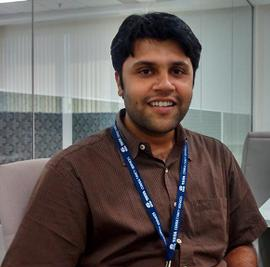
Shibaji Chakraborty
Research Scientist
Space & Atmospheric Instrumentation Lab (SAIL)
Embry-Riddle Aeronautical University · Daytona Beach, FL
- Email chakras4@erau.edu
- Phone +1 (540) 739-0127
- ORCID 0000-0001-6792-0037
- GitHub shibaji7
- Languages English, Bengali
Every major solar storm threatens the technology modern civilization runs on — HF radio communications, satellite navigation, and the submarine fiber-optic cables that carry 99% of the world's transcontinental internet traffic. My research sits at that intersection: I study how solar flares, geomagnetic superstorms, and solar eclipses reshape Earth's upper atmosphere, and I translate those observations into concrete risk estimates for the infrastructure wired into it.
As a Research Scientist at SAIL, Embry-Riddle Aeronautical University, I use SuperDARN radar networks, satellite observations, physics-based models (WACCM-X, TIE-GCM), and machine learning to characterize ionospheric disturbances across a wide range of solar drivers. I build tools that make this science actionable: SCUBAS quantifies geomagnetically induced voltages in globally distributed submarine cable systems — validated against the 1989 and 2003 superstorm records — and pynasonde is an open-source Python library for processing ionosonde data from vertical sounders, now available to the broader space weather community. Both are supported by active funding from Google GARA and two NSF awards.
I hold a Ph.D. in Electrical Engineering from Virginia Tech (2021) and spent five years in software R&D before academia — a background that keeps me focused on building tools that work, not just models that publish. My work has appeared in 38 peer-reviewed journal articles with 500+ citations.
Solar Flares & HF Radio
Shortwave fadeout, Doppler flash, ionospheric sluggishness
Geomagnetic Disturbances
GICs in submarine cables, SCUBAS model, infrastructure risk
Solar Eclipse Ionosphere
EUV response, TID generation, NSF-funded multi-eclipse study
ML for Space Weather
Probabilistic Kp forecasting, neural networks, uncertainty quantification
SuperDARN Radar
HF backscatter, ionospheric electrodynamics, high-latitude physics
Atmospheric Gravity Waves
TIDs, thunderstorm-ionosphere coupling, NASA LWS program
-
2026
Paper published: The impacts of tropospheric gravity wave-generated MSTIDs on skywaves at mid-latitude North American sector observed and modeled using SuperDARN HF radars. Radio Science, 61, e2025RS008464. [DOI]
-
2026
Paper published: Simultaneous multi-point in situ plasma density measurements of a mid-latitude sporadic E layer. Journal of Geophysical Research: Space Physics, 131, e2026JA035164. [DOI]
-
2026
Paper published: pynasonde: An open-source Python library for ionosonde data processing. SoftwareX, 34, 102617. [DOI]
-
Mar 2026
Paper published: Global impacts of ultra-low-frequency waves: 1. Thermospheric responses and traveling atmospheric disturbances. Geophysical Research Letters. [DOI]
-
2025
Google Unrestricted Research Award (GARA): PI — “Quantifying Geomagnetically Induced Voltages in Global Submarine Cables Using the SCUBAS Model.”
-
Mar 2025
Paper published: Formation of the ionospheric G-condition following the 2017 Great American Eclipse. Earth and Space Science. [DOI]
-
Jan 2025
Paper published: Severe weather-generated acoustic and gravity wave impacts on the ionosphere. JGR Space Physics. [DOI]
-
2024
NSF Award PI: Collaborative investigation of ionospheric density response to American solar eclipses (Award #2412294, 2024–2027).
-
2024
NSF-GEM Award PI: Modeling ionospheric and magnetospheric current interactions with submarine cables (2024–2027).
-
Sep 2024
Joined Embry-Riddle Aeronautical University as Research Scientist in the SAIL group under Dr. Aroh Barjatya.
-
2022
JSPS Fellowship: Japan Society for Promotion of Science Postdoctoral Fellowship (Short-term), ISEE — Nagoya University, Japan.
-
2021
Best Paper: IEEE/WiSEE Best Conference Paper Award — Probabilistic Short-wave Fadeout Detection in SuperDARN Time Series.
-
1
Chakraborty, S.*, Inchin, P. A., Debchoudhury, S., Bergsson, B., Zettergren, M., & Ruohoniemi, J. M. (2026). The impacts of tropospheric gravity wave-generated MSTIDs on skywaves at mid-latitude North American sector observed and modeled using SuperDARN HF radars. Radio Science.
-
2
Valentine, H. C., Barjatya, A., Chakraborty, S., Graves, N. P., Clayton, R. E., Debchoudhury, S., et al. (2026). Simultaneous multi-point in situ plasma density measurements of a mid-latitude sporadic E layer. Journal of Geophysical Research: Space Physics.
-
3
Chakraborty, S., Nishitani, N., et al. (2025). Solar Flare-Induced Gradient Drift Instability Observed by SuperDARN HF Radars. Journal of Geophysical Research: Space Physics.
-
4
Chakraborty, S., Qian, L., et al. (2025). Formation of the ionospheric G-condition following the 2017 Great American Eclipse. Earth and Space Science.
-
5
Chakraborty, S., et al. (2022). Modeling geomagnetic induction in submarine cables. Frontiers in Physics.
-
6
Chakraborty, S., et al. (2022). Driving influences of the Doppler flash observed by SuperDARN HF radars in response to solar flares. JGR Space Physics.
-
7
Chakraborty, S., et al. (2021). Ionospheric Sluggishness: A Characteristic Time-Lag of the Ionospheric Response to Solar Flares. JGR Space Physics.