 Shibaji Chakraborty
Solar eclipse glasses have been created for the sole purpose of protecting your retinas should you be lucky enough to experience a solar eclipse. Solar eclipse glasses are specially designed with a so-called solar filter — an elaborate piece of technology engineered to block, among other things, the ‘harmful wavelengths’ of sun radiation. This solar filter blocks light from outside the visible spectrum (polychromatic ultraviolet or UV and polychromatic infrared or IR radiation) perfectly fine, as well as all intense visible light that might escape quantitative absorbance.
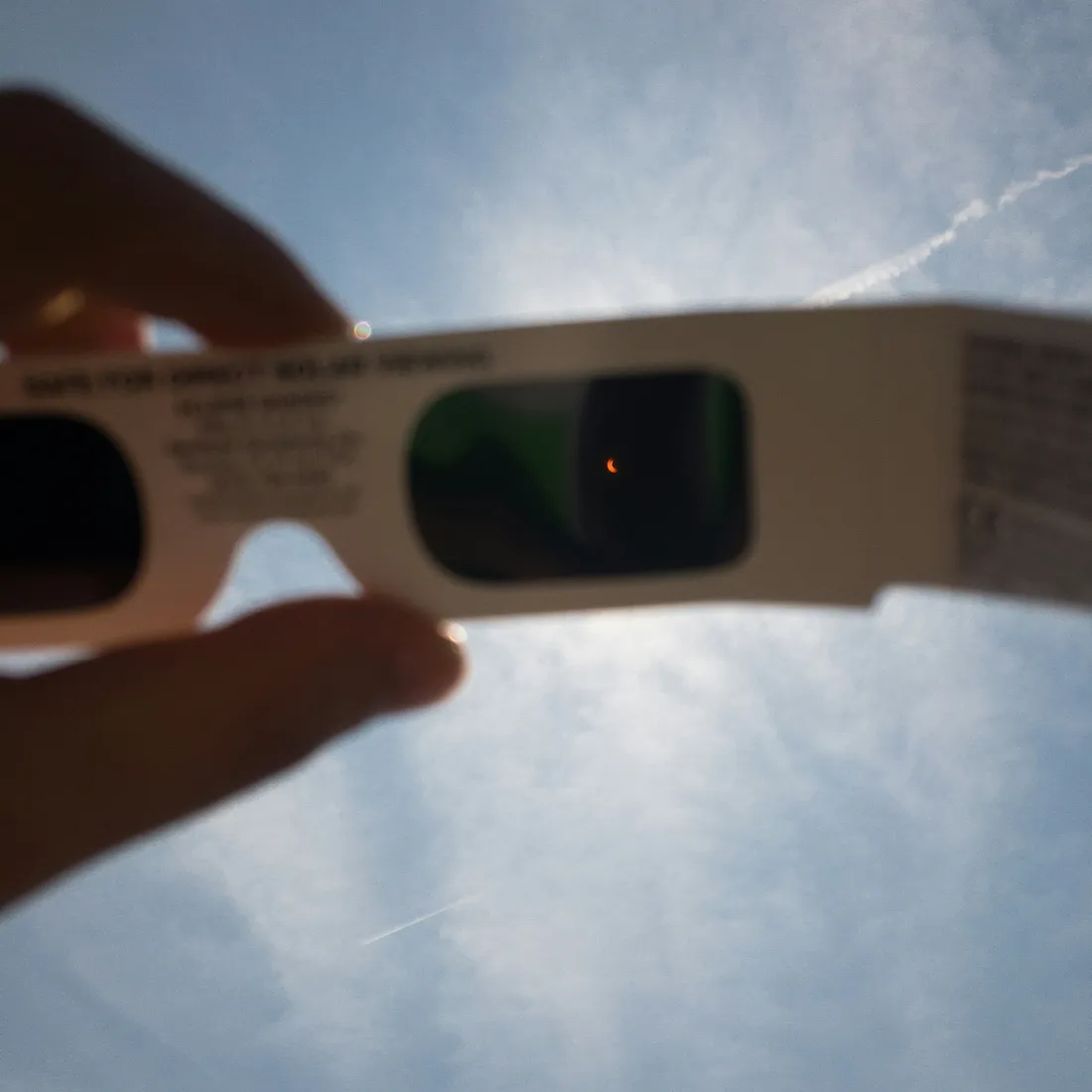
Photo by Jason Howell on Unsplash; typical eclipse glasses distributed by NASA.
What Are They Made Of?
These glasses are constructed differently from regular sunglasses or tinted glasses. While normal sunglasses usually allow between 10 and 20 percent of daylight (specifically, the visible spectrum) to pass through their glasses, the sunlight transmitted can still be too bright for safe viewing of the sun.
Me trying to see the 2017 Great American Eclipse. Photo Credit: Alamy.com.
Rick Fienberg, the press officer for the American Astronomical Society (AAS), explained that the filters specifically designed for viewing the sun are significantly darker, allowing only a minuscule fraction of light to pass through. In fact, these specialized solar filters are typically around 100,000 times (five orders of magnitude) darker than regular sunglasses. He also noted that the majority of ISO-approved eclipse glasses rely on solar filters produced by AstroSolar and Thousand Oaks Optical.
Typically, eclipse glasses are made of a thin metallic film with high optical density. Optical density (OD) of film material is an important parameter that ensures the lenses are capable of providing adequate protection against the bright solar corona during the eclipse. A high optical density indicates better protection against UV and IR radiation, and visible light. Hence, these materials make it safer for viewing the solar disk during events like eclipses.
For example, AstroSolar consists of Baader AstroSolar Silver/Gold Film, which provides eye-sided reflex-free viewing. Additionally, gold blocks infrared (IR) radiation, ensuring there is no unpleasant feeling of warmth in the eyeball. The optical density (OD) of these glasses is OD=5.0, indicating their high level of protection.
A Short Note on Optical Density (OD)
OD quantifies a material’s ability to attenuate the intensity of light passing through it. A material with higher OD can absorb light significantly more than a material with lower OD. For example, a material with an OD=2.0 reduces the intensity of light by a factor of 100 compared to a material with OD=0.
Illustration of optical density (OD) and how it relates to light transmission through solar filter materials.
Are There Alternatives to Metallic Film Glasses?
Yes, there are alternatives to metallic film eclipse glasses. People use the following items: Welder’s Goggles, Pinhole Camera, and X-ray films. X-ray films are the cheapest and most creative way to see the eclipse/sun. The Bureau of Land Management in Arizona once suggested a ‘creative way to view the eclipse’ by using an X-ray to look up at the sun.
However, not all of these alternatives provide adequate protection. Welder’s goggles must be shade 12 or darker to be safe. A pinhole camera projects an image of the sun onto a surface — you never look directly at the sun at all. X-ray films vary widely in optical density and are generally not recommended by NASA or the AAS unless the density has been verified to meet ISO 12312-2 standards.
The safest advice remains: use ISO-certified eclipse glasses from reputable suppliers. They are inexpensive, widely available before eclipse events, and provide the protection your retinas deserve. A solar eclipse is a once-in-a-generation event in any given location — protect your vision so you can see the next one too.